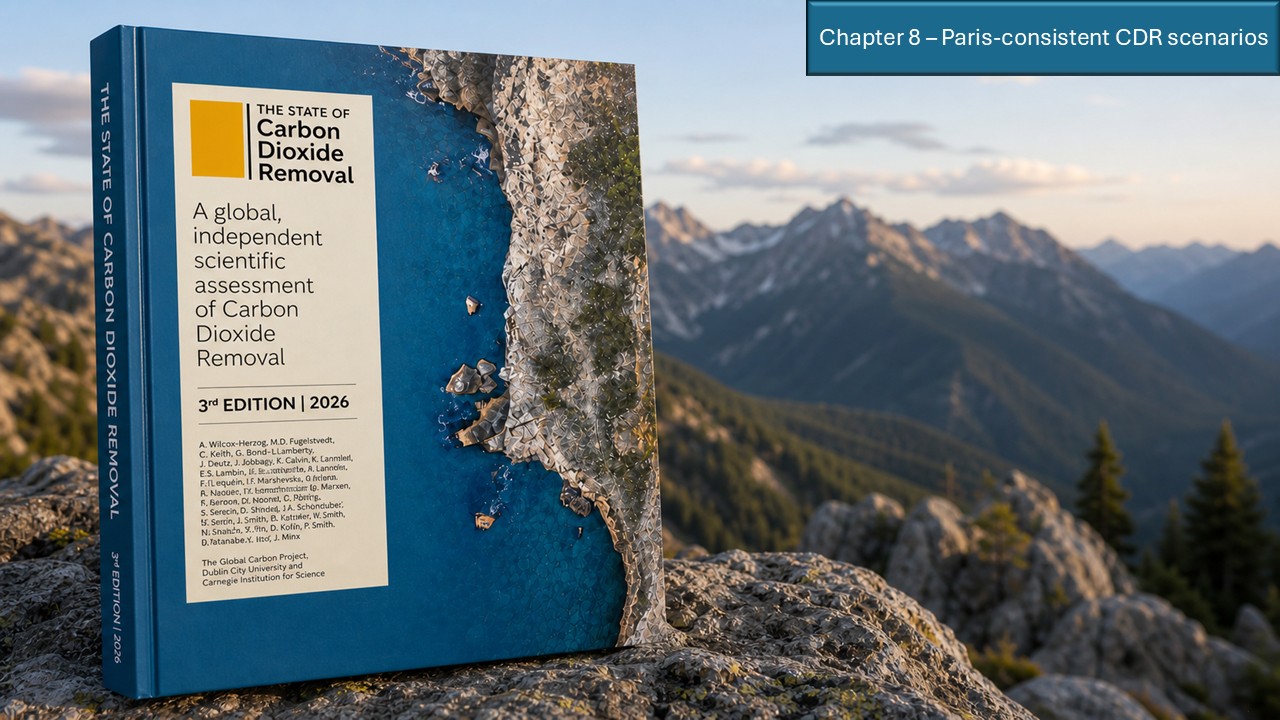
To understand the importance of CDR (Carbon Dioxide Removal), one must know the level of capture, air pollution, and targets intended to be reached. Therefore, the eighth chapter of “The State of Carbon Dioxide Removal, 3rd Edition” report examines what levels of CDR would be consistent with the Paris Agreement, comparing atmospheric capture in integrated assessment models with the CDR observed today and highlighting that required volumes are much larger and combine both conventional and novel methods.
The chapter focuses on scenarios of emissions and removals pathways that limit warming to well below 2°C and, in particular, to 1.5°C. It uses sets of scenarios from integrated assessment models (IAMs) and other studies to analyze how much CDR is deployed in these paths and how it is distributed across methods, regions, and time periods. CDR is always considered in combination with rapid and deep emissions reductions; the chapter emphasizes that CDR does not replace mitigation but accompanies it—first by reducing net emissions, then by offsetting residual emissions, and, in some cases, by contributing to achieving net-negative emissions following a temperature peak.
CDR Levels in Compatible Scenarios
Analyzing maximum ambition scenarios for 1.5°C, the chapter shows that required CDR grows substantially over the century. Around 2030, scenarios combining strong emissions reductions with CDR deploy on the order of 2.9 per year of removals, compared to the 2.2 per year removed today. Towards 2050, CDR in these scenarios reaches levels of several gigatonnes per year, with median values hovering around 8–9 annually, and with some scenarios exceeding the 10 threshold. The majority of these volumes are provided by land-based conventional CDR in the early decades, but novel CDR becomes decisive in the 2030–2050 period.
The scenarios considered show that novel CDR scales from near-zero levels today to tens of megatonnes in 2030 and to several gigatonnes toward mid-century. In many of these pathways, novel CDR grows faster than any known climate technology, expanding at rates similar to or higher than those of solar photovoltaics or electric vehicles during their peak boom phases.
Comparison with Observed CDR and Current Commitments
The chapter compares these levels of CDR with the CDR observed today and with what appears in countries’ Nationally Determined Contributions (NDCs) and long-term strategies. While maximum ambition scenarios for 1.5°C require about 2.9 per year of CDR in 2030, current commitments by countries only reach about 2.5 per year, creating a gap of around 0.3 annually. This gap widens over time: around 1.2 per year by 2035 and more than 5 per year by 2050, when the CDR levels promised by countries fall below all analyzed scenarios consistent with the Paris Agreement.
The chapter also notes that although corporate announcements add up to more than 5 per year of CDR toward 2050, these commitments are not always backed by concrete plans, and their credibility is uneven. Furthermore, a portion of them focuses on high-durability, high-cost novel CDR, raising doubts about their viability without strong supportive and demand-side policies.
Variety of CDR Scenarios
An important feature of Paris Agreement scenarios is that they combine multiple CDR methods. In the short term, up to 2030, conventional CDR dominates: expansion and improvement of forests, agricultural land management, and peatland and coastal ecosystem restoration. In the 2030–2050 period, novel CDR grows rapidly: bioenergy with carbon capture and storage (BECCS), direct air capture with geological storage (DACCS), enhanced weathering, biochar, and other methods shift from offering marginal removals to contributing gigatonne volumes in the most ambitious scenarios.
The chapter insists that none of the scenarios rely on a single method; there is a repertoire of CDR where different approaches complement and, in many cases, limit each other due to land, water, energy, biomass, and social acceptability constraints. It also shows that scenarios relying excessively on one or two specific methods tend to sit closer to sustainability limits.
Scaling Paces and Comparison with Other Technologies
The chapter dedicates space to comparing the growth rates of novel CDR required by scenarios with historical trajectories of other technologies. To illustrate how ambitious yet not totally unprecedented these paces are, analogies are constructed with the expansion of solar photovoltaics, electric vehicles, and ammonia synthesis. The results show that to follow a pathway compatible with 1.5°C, novel CDR would have to grow within a band of rates located between those observed for electric vehicles and solar photovoltaics during their periods of greatest expansion.
The message is twofold: on one hand, the necessary scaling is extremely rapid and demanding; on the other hand, the required rates are not completely unknown in the realm of climate technologies, suggesting that with strong policies and clear demand signals, it might be possible to approach these trajectories.
Sustainability Implications and Limits
The chapter also explores the sustainability implications of deploying CDR at the levels appearing across the various scenarios. It points out that land-based conventional CDR can compete with other uses such as food production and biodiversity conservation, and over-relying on it can generate undesirable pressures on ecosystems and communities. Regarding novel CDR, it warns of potential impacts on energy demand, mineral use, water, and space, as well as the social acceptance of large capture and storage infrastructures.
Consequently, the chapter advocates for designing CDR strategies that remain within reasonable sustainability limits and avoid betting on scenarios requiring CDR deployments at the higher end of estimated potential ranges. Reducing emissions faster in the next decade, it notes, would allow for relying on less CDR in the future and would alleviate some of these pressures.

heliCO2farm
We capture carbon dioxide inspired by nature