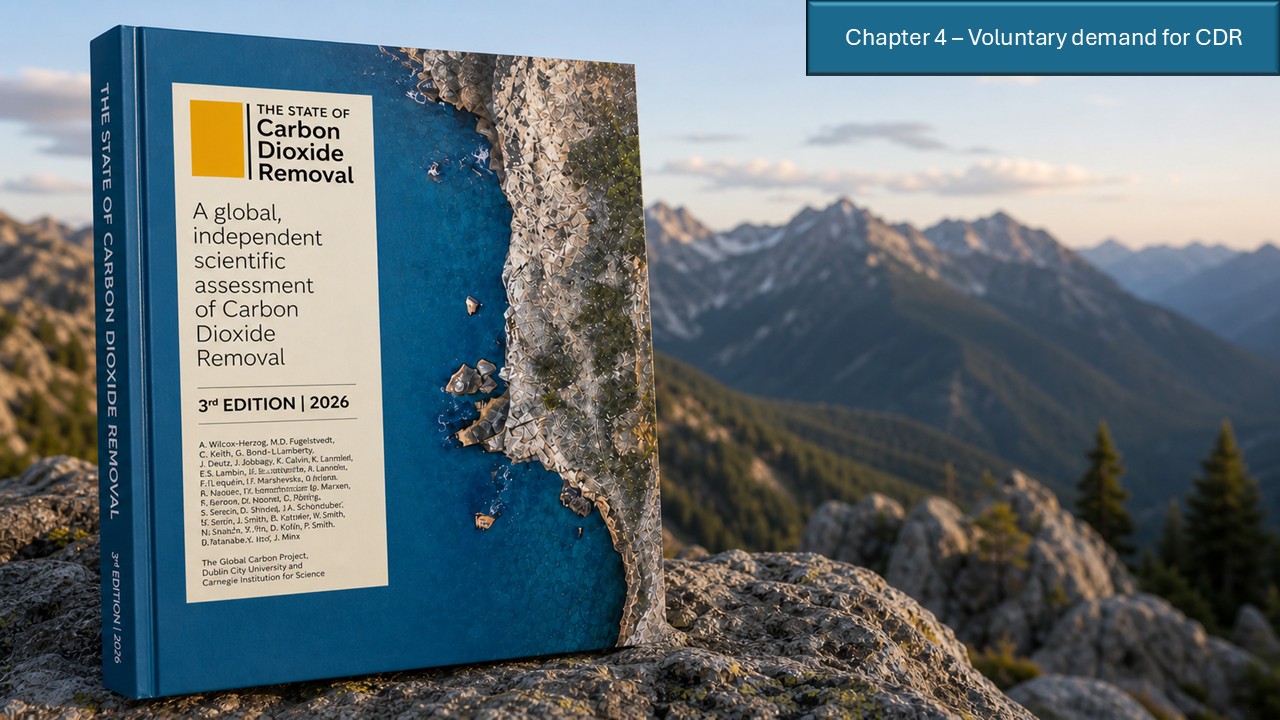
Analyzing the atmospheric capture market and drawing on the fourth chapter of “The State of Carbon Dioxide Removal, 3rd Edition” report, we understand voluntary demand for CDR (Carbon Dioxide Removal) as a key driver to achieve the aforementioned goals.
Voluntary Demand for CDR: A Small Market in Volume but Key in Value
The chapter focuses on voluntary demand for CDR, primarily through the voluntary carbon market (VCM). This demand is presented as an essential driver for financing atmospheric capture projects and experimenting with new technical and governance configurations, though it still represents a small fraction of the total volume of credits transacted in the VCM. The chapter shows that both conventional CDR (based primarily on forestry projects) and novel CDR have experienced significant growth in contracted emissions and issued credits, with novel CDR growing at year-over-year rates exceeding 100% from very low volumes.
By volume, conventional CDR credits clearly dominate the voluntary CDR market: afforestation, reforestation, and forest management projects concentrate essentially all contracts and the majority of issued and retired credits, with totals of 16.1–16.5 issued and 12.7–10.4 retired in 2024–2025. Novel CDR (including BECCS, biochar, DACCS, enhanced weathering, mineral products, biomass sinking, ocean alkalinity enhancement, and others) went from 8.17 contracted in 2024 to 30.2 in 2025, with between 0.62 and 1.25 issued and 0.32–0.63 retired. In terms of monetary value, however, the chapter indicates that the value of novel CDR contracts likely exceeds several times the total value of all VCM transactions in 2024, estimated at about 535 million USD, due to the high prices of these credits and the importance of novel CDR in the climate innovation narrative.
Market Structure: Geographic Concentration and Dependence
A fundamental characteristic highlighted in Chapter 4 is concentration both geographically and by type of buyer. Latin America and the Caribbean host 47% of all CDR credit projects and 74% of conventional CDR projects, reflecting the region’s centrality in forestry, peatland, and wetland projects. Europe, on its part, leads in novel CDR, hosting 48% of all projects of this type, linked to technologies such as biochar, BECCS, DACCS, and mineral products. This territorial concentration implies that changes in policies or economic-environmental conditions in a few regions can disproportionately affect the global supply of CDR credits.
The concentration by type of buyer is even more pronounced. The chapter notes that demand for novel CDR is dominated by a very small set of companies, highlighting that Microsoft acquired more than 80% of all novel CDR credits transacted in 2024–2025. This reliance on one or a few large buyers constitutes a critical vulnerability: any adjustment in their purchasing programs—such as the potential pause in acquisitions reported in April 2026—directly impacts the scaling pace of CDR. The report concludes that for CDR to reach levels consistent with Paris Agreement scenarios, it will be necessary to diversify both the buyer base and demand sources, incorporating mandatory mechanisms and emissions trading systems.
Opportunities and Friction
The chapter dedicates a section to analyzing the emerging role of international mechanisms like Article 6 of the Paris Agreement and the CORSIA scheme for aviation as potential additional sources of CDR demand. Under Article 6.2, it mentions pilots such as the one between Norway and Switzerland to test novel CDR transactions, but notes that no formal cooperative approach centered on CDR has been registered yet. Within the mechanism under Article 6.4, 2,462 projects and programs seeking transition from the CDM have been identified, of which 12 are conventional CDR, although none have received host-country approval yet. Furthermore, 72 out of 1,112 projects that have stated “prior consideration” are CDR, mostly conventional, representing up to 7.7% and 0.0065% of the annual potential for future reduced emissions under Article 6.4 for conventional and novel CDR respectively.
The analysis of the CORSIA scheme is particularly illustrative: the chapter shows that while some airlines voluntarily buy novel CDR credits, many of these credits cannot be used for compliance under CORSIA due to eligibility criteria designed prior to the boom of durable CDR, and that the average prices of CORSIA-eligible credits are well below the costs of most CDR methods. This limits the appeal of novel CDR as a compliance option and underscores the need to reform criteria and create standard frameworks that recognize high-integrity, durable credits. In this sense, the chapter discusses the potential contribution of frameworks like the ICVCM’s Core Carbon Principles, the European CRCF, and the Article 6.4 mechanism standard in converging toward more fungible and higher-quality markets, though it warns of a potential “race to the bottom” if the consistency of the credits’ environmental integrity is not secured.
In its future outlook, the chapter concludes that the VCM will remain crucial for financing and experimenting with CDR projects, but on its own, it is not designed to deliver CDR at the scale required to meet global climate goals. Therefore, it sets as a priority the development of robust standard frameworks, the progressive integration of durable CDR into emissions trading systems, and the creation of mandatory demand sources to complement the voluntary demand currently concentrated in a few large corporations.

heliCO2farm
We capture carbon dioxide inspired by nature