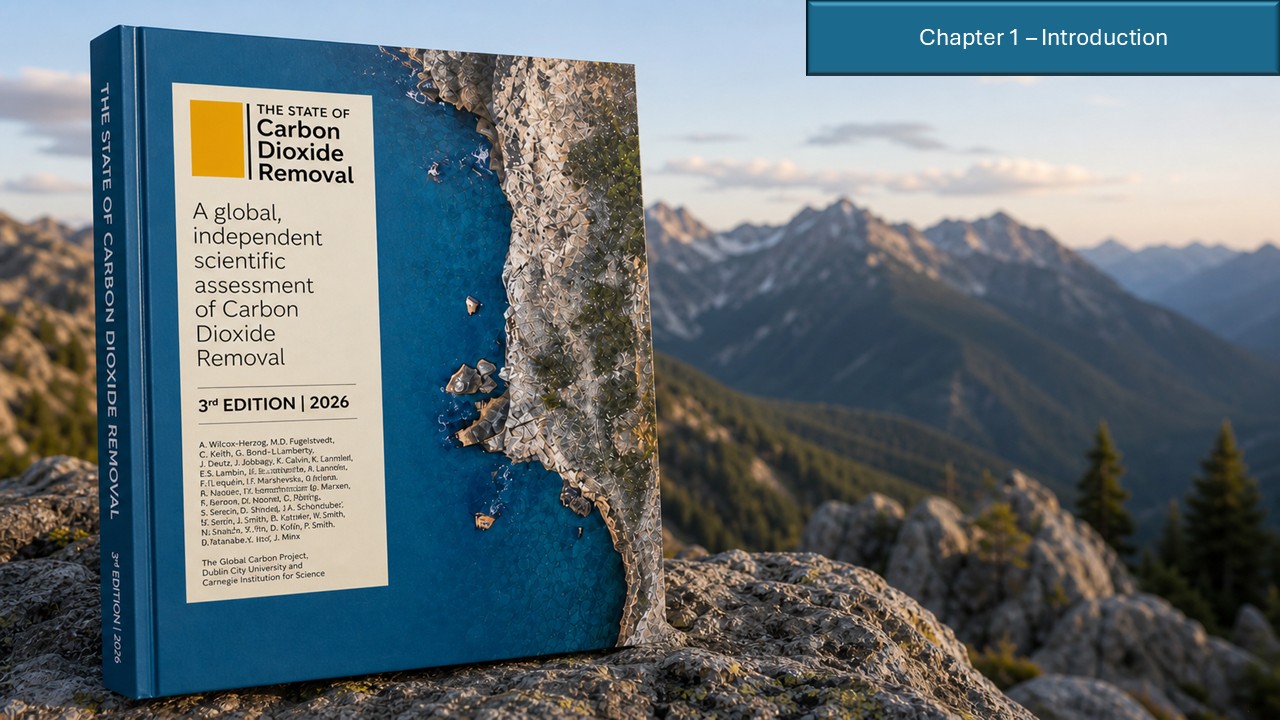
We understand that there are different types of solutions to reduce emissions; therefore, reading the first chapter of the third edition of “The State of Carbon Dioxide Removal” report makes the importance and necessity of CDR (Carbon Dioxide Removal) much clearer.
Why do we need CDR?
Atmospheric carbon dioxide removal (CDR) is defined as the set of human activities that capture directly from the atmosphere and store it durably in geological, terrestrial, or ocean reservoirs, or in products. It is presented as an essential complement—though never a substitute—to accelerated emissions reductions. According to scenarios compatible with the Paris Agreement, at least 80% of the effort to achieve net-zero emissions comes from direct emissions reductions, while the remainder requires deploying CDR at a gigatonne scale. The report reminds us that we are already experiencing the direct impacts of a changing climate, with individual years temporarily exceeding the 1.5°C threshold, and places CDR at the heart of the Paris Agreement architecture and the first Global Stocktake adopted at COP28. The COP30 Presidency has announced the development of two roadmaps to operationalize the Dubai decisions, and it is anticipated that CDR will be a key instrument for managing residual emissions and “legacy carbon” accumulated over decades of intensive fossil fuel use, without becoming an excuse to delay decarbonization or justify unsustainable practices.
CDR Methods: Nature and Technological Innovation
The chapter differentiates between “conventional CDR”—based on forests and soils through reforestation, ecosystem restoration, and management that increases soil organic carbon—and “novel CDR,” which integrates emerging technologies such as biochar, ocean alkalinity enhancement, enhanced rock weathering, and direct air capture with geological storage (DACCS). Each family presents very different profiles regarding costs, removal potential, technological maturity, reversal risks, and social acceptance. Estimated costs vary from less than 10 USD/ in certain nature-based solutions to over 1,000 USD/ in highly complex technologies, with upper limits around 200 USD/ for most methods, which is often above current carbon prices, highlighting the need for specific policies and public support to scale CDR. Technical potentials show wide ranges, but the most robust lower estimates sit around 1 /year per method, constrained by sustainability, resources, and durability.
Costs, Potentials, and Sources of Uncertainty
Uncertainty in costs and potentials is linked to the limited empirical basis of emerging technologies and differences in system boundaries (what is included in the energy and material balance and how co-benefits and collateral damages are treated). For policymakers and businesses, this heterogeneity implies that investment decisions must be backed by transparent, comparable, and methodologically robust analyses, avoiding simplistic comparisons between technologies operating in different contexts.
A central part of the chapter addresses the durability of carbon storage and reversal risks. Since fossil has a very long life in the atmosphere and oceans, the climate contribution of any project depends not only on the amount captured but also on the stability of the sink over relevant timescales. The reversibility of biological sinks—forests exposed to fires, pests, or land-use changes, and soils vulnerable to poor agronomic practices—is contrasted with the greater stability of deep geological reservoirs and certain long-lived mineral products. Literature shows that CDR based on temporary sinks can help reduce peak warming in scenarios well below 2°C, but over-reliance on fragile storage increases climate and governance risks. Therefore, it advocates for CDR strategies that incorporate mechanisms to manage durability and reversal, such as carbon buffers, insurance, or rules that clearly distinguish between temporary and permanent storage. This differentiation prevents mixing credits of varying climate quality in carbon markets, avoiding false illusions of neutrality.
International Climate Policy and Climate Justice
The report underlines the importance of integrating climate justice criteria into the design of CDR standards and markets. Properly designed, market mechanisms can transfer finance and technology from the Global North to the Global South, rewarding innovative solution providers and local communities for conserving ecosystems. Without robust safeguards, they can deepen inequalities, displace communities, or incentivize projects that prioritize credit volume over biodiversity and human rights.
The chapter connects the technical discussion with international climate policy, starting from the gap identified by the Global Stocktake between commitments and effective actions. It argues that CDR must be integrated into national strategies as a complement to mitigation, but never as a substitute for deep decarbonization across all sectors. The focus remains on reducing emissions, accelerating the energy transition, and protecting and restoring nature—forests, wetlands, and marine ecosystems—while the COP30 Presidency (Brazil) prepares two roadmaps to move from promises to tangible, equitable, and durable implementation. It warns that we cannot rely exclusively on uncertain technologies or unsustainable practices “in the name of” CDR, but must articulate it by combining “the wisdom of conservation and justice” with “the promise of innovation,” creating synergies between conventional approaches and high-durability technological methods.
In governance, it emphasizes that harmonizing carbon accounting methods is essential for the integrity of CDR. The coexistence of divergent standards—different definitions of CDR, system boundaries, and treatments of durability and reversal—raises costs, generates inconsistent results, and undermines trust in markets. It recommends moving toward standards built through inclusive processes and global collaboration, aligned with the Global Stocktake’s call for environmental integrity, transparency, and consistency, so that CDR is a credible tool rather than a playground for greenwashing.

heliCO2farm
We capture carbon dioxide inspired by nature