Introduction
Our mission as a startup is to develop an atmospheric capture system that can be subsequently certified. This is why we are integrated into the networks of the different stakeholders developing the regulations, and we must stay up to date with any updates to simultaneously advance our R&D project. Since we want to promote the sector, we are carrying out ongoing dissemination initiatives so that all possible stakeholders (industries, developers, farmers, etc.) can benefit from this new economic sector that is just starting to take off.
CDR – Decarbonization – CRCF
In the dynamic ecosystem of climate change mitigation, Carbon Dioxide Removal (CDR) and the decarbonization of the primary sector have ceased to be secondary options and have become mandatory pillars to achieve climate neutrality by 2050. However, one of the greatest historical hurdles for the development of these projects has been the lack of trust, the fragmentation of methodologies, and the persistent phantom of greenwashing.
To address this challenge, the European Commission has launched the Carbon Removal and Carbon Farming Certification Regulation (CRCF). Through its official portal, the European Union sets the definitive rules of the game to measure, verify, and certify removals on European soil.
Carbon Removal and Carbon Farming (European Commission)
Below, we analyze in depth what the CRCF is, the reason behind this official portal, the high-value resources it offers, and where it projects the future of the carbon market.
What is the CRCF and what is its objective?
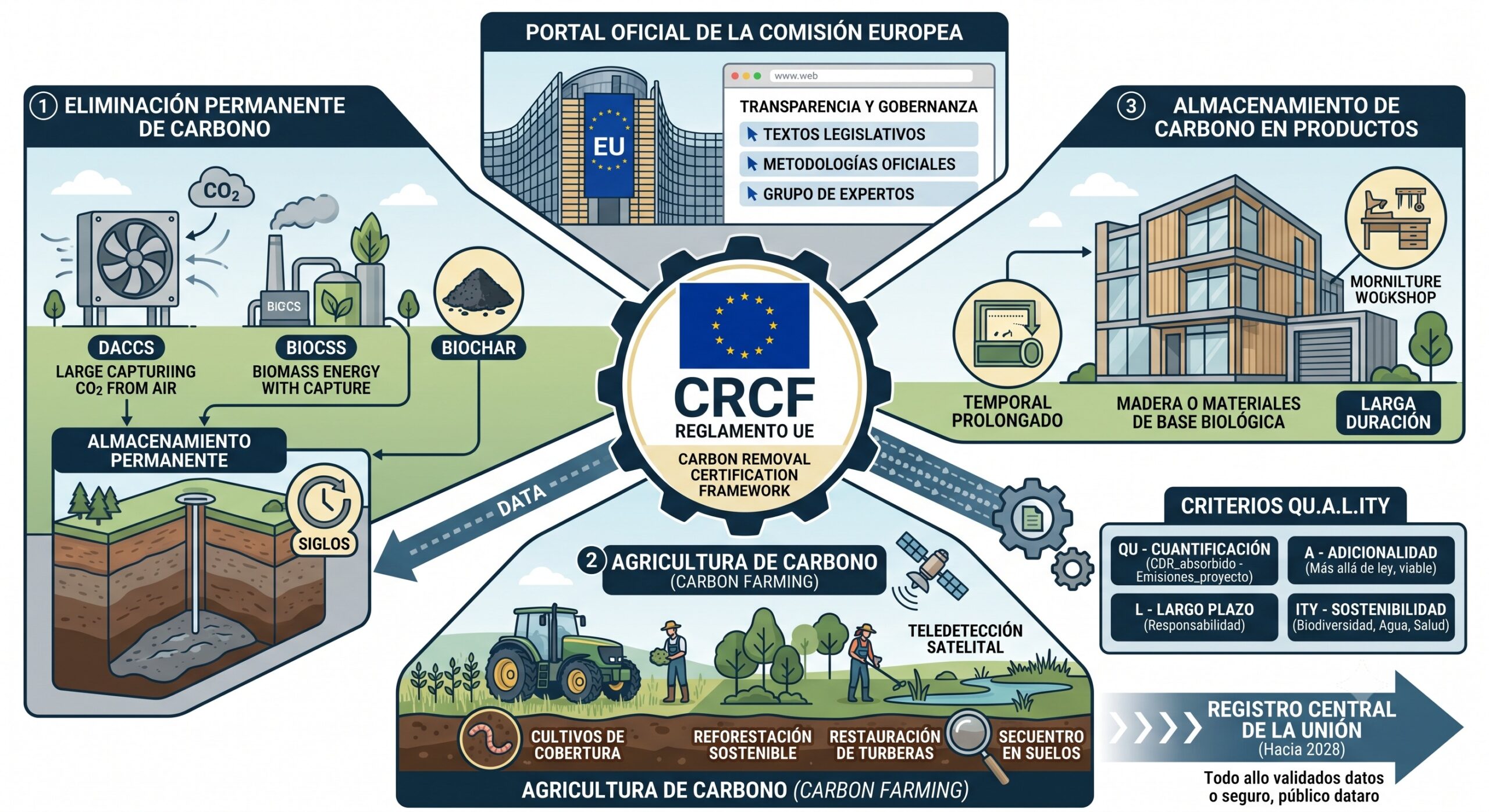
The CRCF (Regulation EU 2024/3012) is the first European-wide voluntary regulatory framework designed to certify net carbon removals, carbon farming, and storage in long-lasting products with scientific rigor.
For a removal activity to obtain the EU certification stamp, it must strictly comply with the so-called QU.A.L.ITY Criteria:
- QU (Quantification): Removals must be measured accurately and transparently, subtracting any greenhouse gas emissions generated during the lifecycle of the project itself.
- A (Additionality): The project must go beyond standard practices and the minimum requirements demanded by law. Furthermore, the incentive of obtaining the certificate must be crucial for its financial viability.
- L (Long-term storage): The certificate is directly linked to the duration of the carbon storage. If there is a risk of being released back into the atmosphere, clear liability mechanisms must be in place.
- ITY (Sustainabil-ITY): Activities must not only capture carbon but also respect and enhance other environmental objectives, such as biodiversity, water regeneration, and ecosystem health.
The Three CRCF Action Categories
The regulation divides certifiable activities into three major blocks to accommodate both cutting-edge technological solutions and nature-based management:
- Permanent Carbon Removal
- Industrial or biological processes that capture from the atmosphere and store it permanently for centuries.
-
- Examples: Direct Air Capture with Carbon Storage (DACCS), Bioenergy with Carbon Capture and Storage (BioCCS), and Biochar Carbon Removal (BCR).
- Carbon Farming
- Agricultural and forestry practices that increase sequestration in soils or biomass, or reduce greenhouse gas emissions from the soil.
-
- Examples: Sustainable reforestation, agroforestry, peatland restoration, cover crops, and fertilizer optimization.
- Carbon Storage in Products
- Fixing carbon of biogenic origin in long-lasting products, preventing it from returning rapidly to the atmosphere.
-
- Examples: Use of wood or bio-based construction materials in buildings (prolonged temporary storage).
Why does this official European Commission website exist?
The Commission’s official web portal is the epicenter of transparency and governance for this regulation. Its existence responds to the need to build trust for investors and project developers.
Instead of relying on private registries or heterogeneous standards, this portal acts as the official bulletin board of the regulatory framework. It centralizes all secondary legislation (delegated acts and implementing regulations) and provides visibility to the scientific work behind each carbon methodology.
Recent Milestone: CRCF Certification Methodologies
In early 2026, the European Commission formally adopted the first package of harmonized methodologies for permanent carbon removal, covering key technologies such as DACCS, BioCCS, and Biochar. This marks the definitive transition from theoretical legislation to the practical implementation of auditable projects.
What key resources and tools can we find on the portal?
As communicators and disseminators, this website is a goldmine of information and technical data ready to be analyzed and shared:
- Full Legislative Texts: Allows downloading the main regulation and its technical implementation annexes, which are ideal for understanding the audit rules and credentials of certifying bodies.
- Official Certification Methodologies: Access to approved technical documents for critical technologies (such as DACCS, BioCCS, and BCR), providing precise knowledge of climate accounting equations and monitoring requirements.
- Carbon Removals Expert Group: A public section compiling minutes, presentations, and debates from the scientists and professionals advising the European Commission on developing future methodologies.
- The EU CRCF Buyers’ Club: A space dedicated to this innovative Commission initiative that brings together investors, corporate buyers, and suppliers to accelerate demand for certified credits, ensuring stable revenues for farmers and CDR projects.
- The Carbon Farming Database: A resource designed to lower measurement costs by providing models, satellite remote sensing, and baseline data on soil emission factors.
Where does the portal redirect us? (Governance and the Future)
The official portal also serves as a bridge to future market tools:
- Union Central Registry (Towards 2028): The website will redirect to the EU’s centralized database where all certificates will be publicly registered, ensuring that every single ton of absorbed is traceable, holds a unique number, and is not double-counted.
- Open Public Consultations: Participatory spaces where researchers and disseminators can submit feedback to shape upcoming regulations (for example, livestock emissions certification or storage in buildings).
- Synergy Policies: Links to other major European strategies, such as the Green Claims Directive to curb misleading environmental advertising, and the Bioeconomy Strategy.
Conclusion: The takeoff of the regulated CDR era
The launch of this portal and the consolidation of the CRCF Regulation mark the transition from theory to practice. For the and CDR sector, we are no longer talking about an uncontrolled voluntary market; we are witnessing the birth of a high-integrity global standard regulated by an economic superpower. For companies, farmers, and scientists, understanding and monitoring this portal is vital to leading the climate transition over the next decade.

heliCO2farm
We capture carbon dioxide inspired by nature