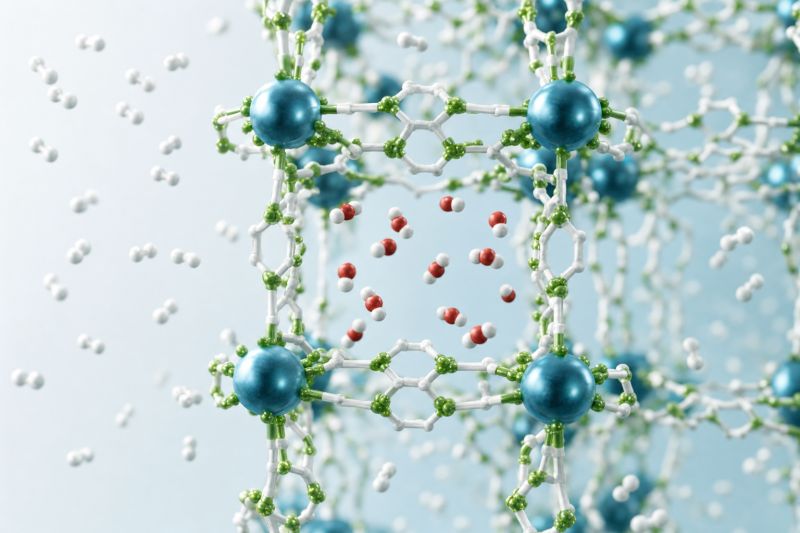
The University of Zaragoza and INMA have just published a new direct air CO₂ capture technology based on ultra-thin membranes with MOF materials in the journal Advanced Materials, a breakthrough set to play a key role in the fight against climate change. These porous materials, recognized with the Nobel Prize in Chemistry in 2025, allow CO₂ to be separated from ambient air with high precision, even at the typical low concentrations found in the atmosphere.
At heliCO₂farm, we are especially proud of this news: we maintain an R&D agreement with the Nanostructured Materials Membrane and Catalysis Group (MECANOS) from the University of Zaragoza, the team behind this research. Through this collaboration, we explore and develop specific adsorbent rotors and MOF membranes for modular and scalable Direct Air Capture (DAC) systems.

Our joint goal is clear: to design materials and components with high CO₂ affinity, lower energy consumption, and greater durability to accelerate the real-world deployment of carbon removal solutions. The combination of advanced nanotechnology with our biotic capture approach turns heliCO₂farm into a hybrid system with a high potential for climate impact.
This new scientific result reinforces the conviction that the solution to the climate crisis relies on integrating biology, materials chemistry, engineering, and digitization, as well as forging strong alliances between universities and startups. From heliCO₂farm, we will continue to share the upcoming milestones of this collaboration, from new DAC module designs to future carbon farm prototypes.
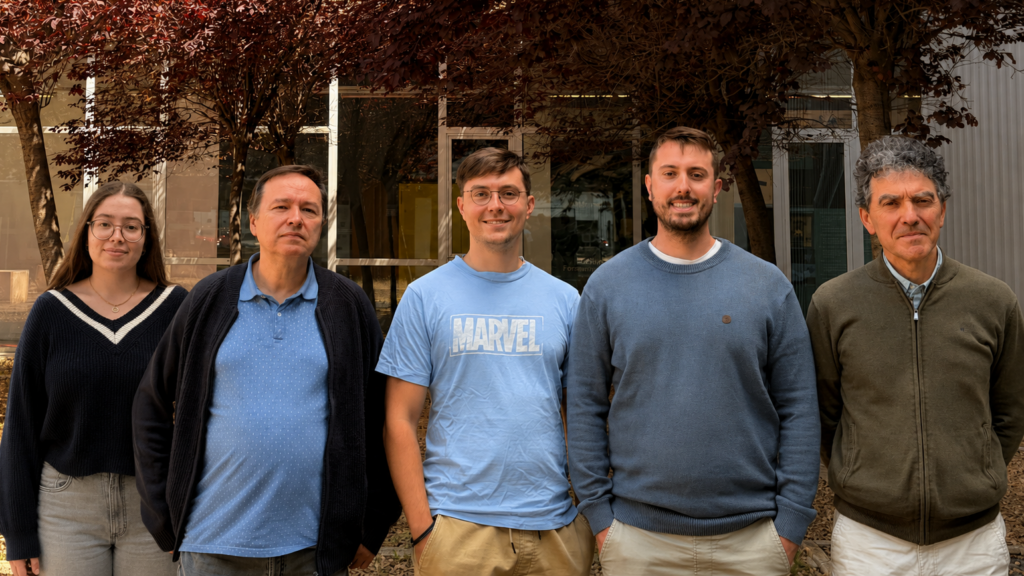
Photo Caption / Credits:
In the photo, from left to right: Lucía Carrillo (PhD student), Carlos Téllez (University Professor), Íñigo Martínez (researcher who will shortly defend his doctoral thesis on this topic), José Miguel Luque (postdoctoral fellow from the “La Caixa” Foundation who has just obtained a Ramón y Cajal postdoctoral contract), and Joaquín Coronas (University Professor).
Carlos Téllez and Joaquín Coronas are the principal investigators of the project “Direct air CO2 capture with thin-film nanocomposite membranes based on MOF, PID2022-138582OB-I00”, from the Ministry of Science, Innovation and Universities of the Government of Spain through the State Research Agency and co-financed by the European Regional Development Fund.
The article has been published at the following address:
Link to the news article in the Heraldo de Aragon